
Wooden Mandir Vastu Guide: Best Direction, Placement Rules & Pooja Room Tips
Planning a wooden mandir for your home involves more than choosing carving, storage and finish. In traditional Vastu practice, the direction of the temple, idol orientation, height, surrounding space and relationship with nearby rooms are also considered important.
The placement recommendations in this article describe traditional Vastu Shastra beliefs and contemporary Vastu guidance. Claims about “positive energy,” prosperity or other outcomes are matters of tradition and belief, not established scientific effects. Practical considerations such as safety, ventilation, fire risk and available space should also guide your setup.
What is the best direction for a wooden mandir at home?
According to commonly followed Vastu guidance, the north-east (Ishaan) corner is considered the preferred location for a home mandir or pooja space. If the north-east is not practical, east or north are commonly suggested alternatives. Many Vastu sources also recommend arranging the shrine so the person praying can face east or north. :contentReference[oaicite:1]{index=1}
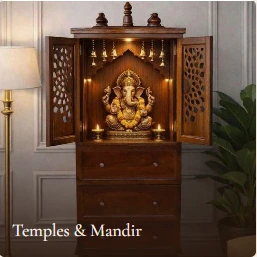
Best direction for a temple at home according to Vastu
The clearest agreement across current Vastu guides is around the north-east or Ishaan corner. It is traditionally associated with sacred use and is widely described as the first choice for a pooja room or home temple. East and north are commonly given as alternatives if the north-east is unavailable. :contentReference[oaicite:2]{index=2}
North-East
Traditionally regarded as the preferred Ishaan zone for a home temple or dedicated pooja space.
East
Commonly recommended when a north-east placement is not possible and is associated in Vastu practice with morning light.
North
Also frequently suggested as a workable alternative where the plan does not allow the preferred corner.
| Direction | Typical Vastu Guidance | Practical Design Note |
|---|---|---|
| North-East | Most commonly preferred | Keep the zone clean, visually light and uncluttered |
| East | Common alternative | Useful where morning light enters naturally |
| North | Common alternative | Can work well as a dedicated wall-mounted or floor mandir |
| South / South-West | Often discouraged in current Vastu guidance | Consider another wall or a specialist consultation if Vastu is important to you |
Which direction should you face while praying?
Many current Vastu guides recommend facing east or north while praying. One common arrangement is to place the idols so they face west, allowing the worshipper to face east. However, guidance on idol orientation is less uniform than the overall north-east placement recommendation, so homeowners who follow a specific religious tradition may wish to prioritise that tradition. :contentReference[oaicite:3]{index=3}
A practical Vastu-oriented mandir arrangement
Place the mandir in the north-east where practical, keep the shrine raised from the floor, maintain a clean dedicated area, and arrange the prayer position so you can face east or north. If your floor plan does not allow this, east or north placement is commonly used as a practical alternative.
Important wooden mandir placement rules
Direction receives the most attention, but placement within the room also matters in traditional Vastu advice. Current guides repeatedly recommend a dedicated, clean and uncluttered shrine rather than treating the mandir like an ordinary storage unit. :contentReference[oaicite:4]{index=4}
- Prefer the north-east area where the floor plan allows it.
- Use east or north as common alternatives.
- Keep the mandir and pooja area clean and organised.
- Raise the sacred platform rather than placing idols directly on the floor.
- Provide enough space to sit or stand comfortably during prayer.
- Keep oil lamps and incense safely away from combustible wooden surfaces.
- Avoid crowding the shrine with unrelated storage.
- Plan electrical points for lighting before the mandir is installed.
- Leave enough ventilation around enclosed wooden cabinetry.
- Consider maintenance access for lamps, flowers and everyday pooja items.
Can you place a wooden mandir in the living room?
Yes. A separate pooja room is not possible in many modern homes and apartments. Current Vastu guidance commonly accepts a dedicated mandir nook in a living space when the preferred direction and cleanliness can still be maintained. :contentReference[oaicite:5]{index=5}
A floor-standing wooden mandir, wall niche or custom corner unit can be designed around the available space. Visually separating it from the TV unit, shoe storage or heavily used utility areas usually creates a calmer setup even apart from Vastu considerations.
Wooden mandir Vastu for apartments and small homes
Apartment layouts often make textbook placement impossible. In that situation, a practical approach is more useful than forcing a mandir into an unsuitable corner merely to satisfy a compass direction.
Current Vastu guides generally suggest prioritising the north-east where available, then east or north, and keeping the shrine in a dedicated clean area even if it is compact. :contentReference[oaicite:6]{index=6}
Wall-mounted mandir
Saves floor area and can be positioned at a comfortable viewing and worship height.
Dedicated mandir cabinet
Creates visual separation while allowing drawers or shelves for pooja essentials.
Full-height temple unit
Allows more elaborate carving, storage, bells, lighting and a complete architectural backdrop.
Why choose a wooden mandir for home?
Wood works naturally with carved columns, arches, jaali work, doors and traditional temple motifs. It can also be adapted to contemporary interiors using simpler lines, lighter carving and concealed storage.
A custom wooden mandir can be planned around the available wall width, ceiling height and storage requirement rather than forcing the homeowner into a fixed retail size.
VAVA Woods works on made-to-order wooden mandirs, carved woodwork and custom architectural pieces , so the size, carving language, wood, polish and storage can be developed around the individual home or project.
What size should a wooden mandir be?
There is no single Vastu size that fits every home. The practical dimensions should allow enough space for the idols, lamps, pooja items and safe daily use without overcrowding.
Instead of selecting the largest temple that fits the wall, consider the proportions of the room. A compact apartment may suit a wall-mounted mandir, while a villa or dedicated pooja room can support a taller carved structure with doors and storage.
Should a wooden mandir have doors?
Doors are primarily a design and ritual preference rather than a universal requirement. A pair of carved or jaali shutters can create visual separation and keep the shrine protected when not in use.
If doors are included, make sure they can open fully without obstructing the worship area. Ventilation should also be considered if lamps or incense are used inside an enclosed wooden mandir.
Lighting and diya safety in a wooden mandir
This is one area where practical safety should override decorative preference. Oil lamps, candles and incense create heat and open flame, while wood is a combustible material.
- Keep diya flames away from the wooden roof and side panels.
- Use a suitable metal or stone tray below oil lamps.
- Do not leave a flame unattended.
- Provide ventilation where the mandir has doors.
- Keep electrical wiring and LED drivers accessible for maintenance.
- Avoid overheated decorative lighting inside enclosed timber cabinetry.
Common mandir placement mistakes to avoid
Current Vastu guides commonly advise against locating a shrine directly beside or against a toilet area, underneath a staircase, or in a cluttered utility zone. Some also discourage placement in a bedroom when another suitable location is available. :contentReference[oaicite:7]{index=7}
- Do not place the mandir directly beside a toilet where avoidable.
- Avoid using the space under a staircase as the first choice.
- Do not use the mandir cabinet as miscellaneous household storage.
- Avoid broken or unstable shelves and unsafe electrical fittings.
- Do not crowd the idol platform with too many unrelated objects.
- Avoid placing open flame too close to timber surfaces.
How to design a custom wooden mandir around Vastu requirements
The best time to think about Vastu is before the mandir is manufactured. If you already know which wall or corner is available, the unit can be designed around the exact width, height, prayer position and storage requirement.
| Design Decision | What to Specify |
|---|---|
| Location | Room, wall and compass direction |
| Available space | Exact width, height and depth |
| Mandir format | Wall-mounted, floor-standing or full-height temple unit |
| Style | Traditional carved, temple-arch, jaali or contemporary |
| Storage | Drawers, shelves or pooja-item compartments |
| Lighting | LED provision and accessible electrical points |
| Doors | Open shrine, carved shutters or jaali doors |
| Finish | Natural, darker polish or project-specific finish |
Planning a custom wooden mandir?
VAVA Woods by RS Exports works on made-to-order wooden temples, carved architectural pieces and custom project requirements. For a useful design discussion, share the actual space rather than only sending a reference image.
- Available width, height & depth
- Room / wall location
- Preferred design style
- Reference image
- Wood preference
- Storage requirement
- Door / jaali requirement
- Finish preference
- Project / delivery location
Frequently asked questions about wooden mandir Vastu
Which direction is best for a wooden mandir at home?
In traditional Vastu guidance, the north-east or Ishaan corner is most commonly preferred. East or north are frequently suggested alternatives when a north-east location is unavailable.
Which direction should I face while praying?
Many Vastu guides recommend facing east or north during prayer. The exact idol orientation may vary between traditions, so religious practice can also be considered.
Can a mandir be placed in the living room?
Yes. In homes without a dedicated pooja room, a clean and dedicated living room corner or wall is commonly used. North-east, east or north are often preferred when practical.
Can a mandir be placed under a staircase?
Many contemporary Vastu guides advise against making the area under a staircase the primary pooja location. If Vastu is important to your family, a different dedicated wall or corner is generally preferred.
Can a wooden mandir be placed in a bedroom?
A separate or more dedicated space is generally preferred in Vastu guidance. In a very small home, practical constraints may require compromise, in which case maintaining cleanliness and visual separation becomes especially useful.
Does a wooden mandir need doors?
Not necessarily. Doors are a design and ritual preference. Open mandirs, carved shutters and jaali-door designs can all work depending on the room, available space and desired appearance.
Can VAVA Woods make a custom mandir according to my available space?
VAVA Woods follows a made-to-order approach, so dimensions, carving, storage, doors, wood and finish can be discussed according to the available space and project requirement.
Planning a wooden mandir for your home?
Share your available width, height, room location, reference design and project city with VAVA Woods to discuss a made-to-order wooden temple.